

Train for Radio with 1‑to‑1 Mentorship—In‑Station or Virtual
If you want a career in radio, you don’t just need information—you need structured practice and feedback that helps you improve fast.
This diploma mentorship program pairs you with an experienced broadcast mentor (in‑station or virtual), guides you through practical assignments, and helps you build skills and materials you can use to pursue opportunities with confidence.
How the Radio Mentoring Program Works
Tell Us Your Goal
Becoming a radio DJ, talk/podcast host, or newscaster—or, if you’re not sure yet, we’ll help you choose the best fit.
Get Matched with a Professional Mentor
We match you with an experienced broadcaster or coach based on your goals, format, and availability—local when possible, virtual when needed.
Train on a Schedule You Choose
Your training schedule is coordinated around your availability, so you can learn at a pace that works for you.
Build Skills and Industry Connections
You follow a professional curriculum, complete hands-on projects, and receive coaching and guidance designed to help you move forward in broadcasting.
Train 1‑on‑1 With a Working Radio Broadcaster Near You
You learn faster when someone experienced can hear what you’re doing—and tell you what to change.
Your training is built around one‑to‑one mentoring and practical assignments. Your schedule is coordinated around your availability so you can build skill without being locked into fixed class times.
Choose the track that fits your goal:
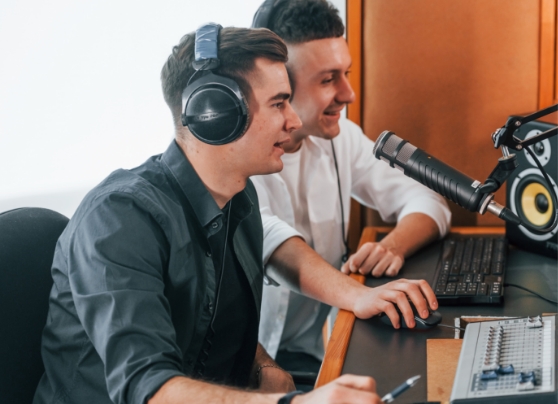

Track 1: Radio DJ
Train for music-format radio with a mentor who understands pacing, breaks, content prep, and what stations listen for when evaluating talent.

Track 2: Podcasting (Portfolio + Reps)
Build publishable practice segments to improve consistency, demonstrate growth, and create clips you can share with confidence.

Track 3: Newscasting
Train for broadcast news delivery with a professional who can help you write tighter, speak clearer, and sound credible under time pressure.
Radio Training Built for the Studio—Not the Classroom
Most broadcasting programs teach concepts. This program is designed to help you perform—on mic, in a real workflow, with real coaching.
The curriculum focuses on the skills that shape results in radio: delivery, show structure, interview technique, vocal control, and how to build a demo that represents you well.
You’ll work through 14 core modules and apply them through mentor-guided assignments.
Learn how to sound natural, clear, and consistent—so you don’t just “talk,” you host.
Learn how to prepare quickly, ask better questions, listen actively, and guide a guest without sounding scripted.
Improve articulation, pacing, breath, and emphasis—so you sound credible and easy to follow.
Learn how to open strong, move cleanly through segments, and land the close with confidence.
Use podcasting to publish practice work, develop consistency, and build clips you can share.
Comprehensive Job Placement Assistance You Can Count On
There’s no set formula for breaking into broadcasting, but two things always matter: proven skills and the right industry contacts.BSMG’s four-step job placement framework helps you build both—so you can demonstrate your talent and start connecting with the people who open doors in this field.

1. Build a Demo + Resume That Sounds Hireable
Get help shaping materials that fit the roles you’re pursuing—so you’re not sending generic submissions into a competitive market.

2. Interview Like Someone Who Belongs in the Room
Learn how to communicate confidence without pretending—so decision-makers hear potential, not uncertainty.

3. Find Real Openings (Not Just Job Boards)
Learn how hiring often works behind the scenes—and how to pursue legitimate entry points.

4. Get Introductions When It Matters
As you build skill and professionalism, you gain access to mentors and networks that help you get in front of the right people.

1. Build a Demo + Resume That Sounds Hireable
Get help shaping materials that fit the roles you’re pursuing—so you’re not sending generic submissions into a competitive market.

2. Interview Like Someone Who Belongs in the Room
Learn how to communicate confidence without pretending—so decision-makers hear potential, not uncertainty.

3. Find Real Openings (Not Just Job Boards)
Learn how hiring often works behind the scenes—and how to pursue legitimate entry points.

4. Get Introductions When It Matters
As you build skill and professionalism, you gain access to mentors and networks that help you get in front of the right people.
Since 2008, We Have Trained Hundreds of Students to Break into the Broadcasting Industry


Not sure which path?
Interested in Radio DJ training?
Interested in sports broadcasting?
Interested in talk formats?
Tuition & Payment Options
You can review current tuition, discounts, and financing options on our Tuition page. If you prefer, connect with an advisor first and get clear answers before you decide.
Transparent pricing. No pressure.
Interested in Learning More? Connect with BSMG.
If you are interested in learning more about our radio mentoring programs, the quickest way to get your questions answered is to connect with BSMG.
You can get help with:
-
 Choosing the right track for your goal
-
Understanding how mentor matching works
-
Confirming station and schedule flexibility
-
Reviewing tuition, discounts, and payment options
Talk With an Advisor
Get your questions answered and find out what training could look like for your schedule.
BSMG will be in contact within 1 business day.
Got Questions? Here are some of the most common questions about our mentoring programs
BSMG pairs you for training with a working broadcaster or sportscaster in your area. You choose the station and decide what days and times you’ll be training.
For more details about this topic, see the Radio Mentoring Guidebook.
Yes! If you have a radio station within acceptable driving distance of your location, we can place you with a mentor.
For more details about this topic, see the Radio Mentoring Guidebook.
Every radio station in your local area is a candidate to work with a BSMG-placed student. Rest assured, you will be placed with an experienced broadcaster who is well-connected to the broadcasting industry and your community.
For more details about this topic, see the Radio Mentoring Guidebook.
You determine your training schedule so that it’s tailored to your availability. Most students go into the station anywhere from one to three times every week. Our curriculum also involves training and education that you’ll complete on the days you’re not at the station.
For more details about this topic, see the Radio Mentoring Guidebook.
Since you will be a class of one, the “best time” to get started is whenever you’re ready to take the next steps in realizing your dream as a future radio broadcaster.
For more details about this topic, see the Radio Mentoring Guidebook.
BSMG does offer financing, but because we are a career vocational training school, we are unable to offer federal financial aid in the form of Pell grants, FAFSA, or Stafford loans.
For more details about this topic, see the Radio Mentoring Guidebook.
Fill out our contact form or call us directly at 818-879-0858 from anywhere in the U. You’re guaranteed to speak with a real person who is happy to answer your questions and guide you through the next steps. We will never pressure you to make a decision you’re not ready to make.